
If you’ve seen a Gymstick session, you might have noticed two people lifting the same kind of bar and wondered whether they’re both working equally hard. They can be doing the same exercise with quite different levels of resistance. That’s what makes the Gymstick so useful when you’d like to train alongside someone who’s stronger than you, or when you’re finding your feet in a group.
I’m Judit, and I teach Gymstick training in Naxxar, Malta. You can try it one-to-one, share a personal training session between two or three people, or join a group class. Whichever you choose, one of the first things I’ll show you is how to adjust the resistance yourself.
What is a Gymstick, and how does it work?
A Gymstick is a lightweight bar with an elastic tube attached at each end. The tubes have loops for your feet. With your feet in the loops, lifting the bar stretches the tubes. The pull you feel comes from that stretch. Across a session, we can use the same piece of equipment for leg exercises, pulling movements for the upper body and exercises that ask you to keep your trunk steady. You can see the bar and tubes on the Gymstick Original equipment page.
Take a standing biceps curl as an example. With your feet in the loops, you hold the bar in front of your thighs, bend your elbows to lift it, then lower it again. The first few repetitions tell us quite a bit. Can you lift the bar without swinging your body? Can you lower it smoothly, even towards the end of the set?
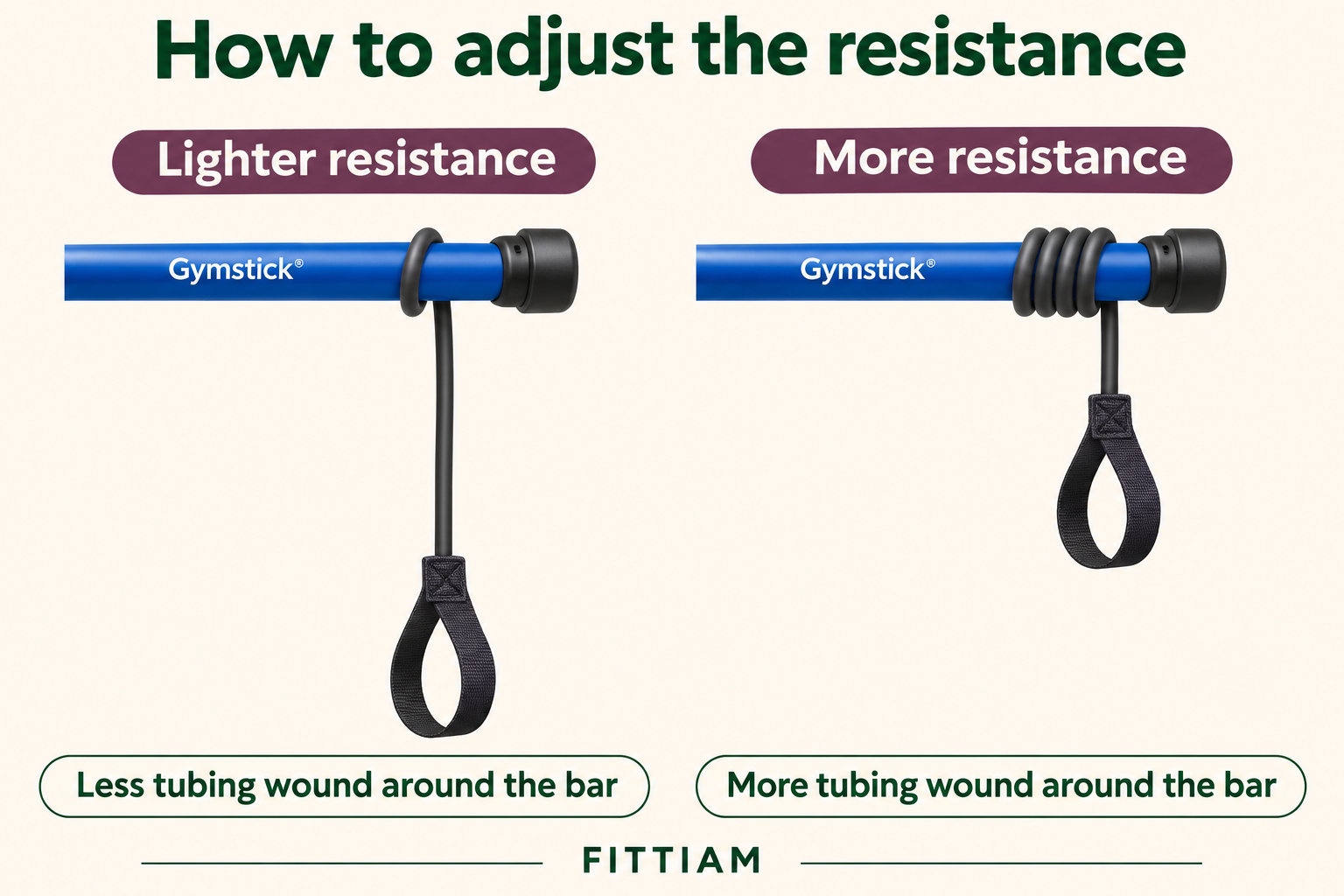
If you’d like a little more resistance, I’ll show you how to wind some of the tubing around the bar. That leaves a shorter length of tubing to stretch. You can unwind it again for a lighter pull. You can make a fresh choice for each exercise. A resistance that feels comfortable for your legs may feel quite different when you’re working your arms.
Which muscles can you work with a Gymstick?
A Gymstick session can work your legs, hips, back, chest, shoulders and arms. Your abdominal muscles also have a part to play, particularly when you need to keep your body steady as you move the bar. Which muscles do most of the work depends on the exercise we choose.
| Movement | Where you might feel the effort |
|---|---|
| A squat or lunge | Mainly in the front of your thighs and your buttocks as you push through your feet to stand. |
| A rowing movement | In your upper back, the backs of your shoulders and your biceps as you draw the bar towards you. |
| A forward press | In your chest, the fronts of your shoulders and your triceps as you push the bar away. |
| A standing curl | Mainly in your biceps as you bend your elbows. Your trunk muscles also help you stay steady as the tension increases. |
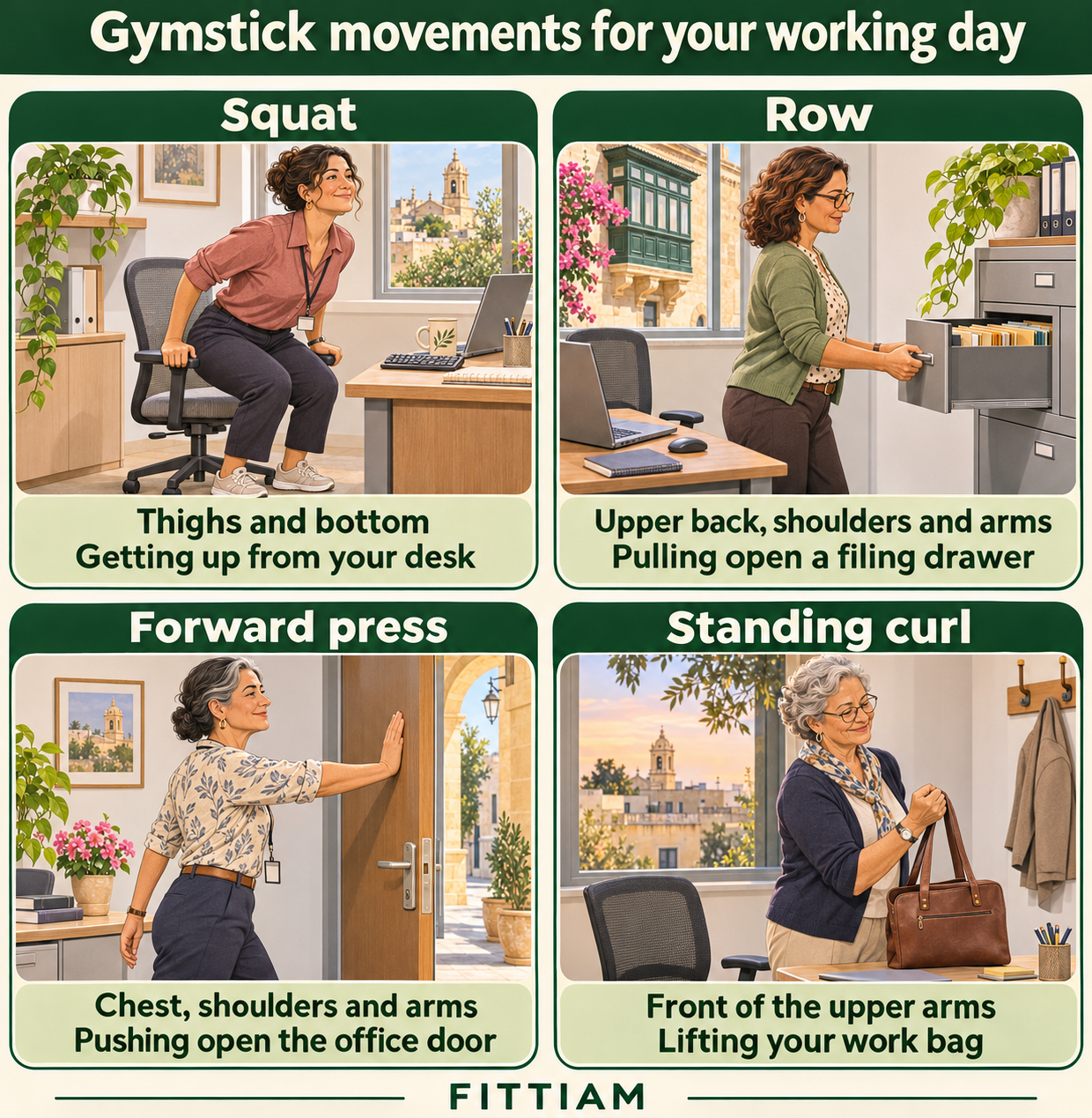
Getting up from your desk, pulling open a filing drawer, pushing a door open and lifting your work bag all use muscles you can work with a Gymstick.
If you’re a beginner, we might start with a shallow squat and light resistance. That gives you time to find a comfortable stance and practise standing up smoothly. If you already train regularly, we might use the same squat with more tension or a slower lowering phase. You may find that controlling the last few centimetres on the way down is the most demanding part. In a shared session or group class, two people can work side by side on the same movement and each find it challenging for a different reason.
Where might that strength help in everyday life?
Think about something you’d like to find a little easier. Perhaps it’s getting up from a low sofa, managing the steps to your flat or carrying the shopping in from the car. A squat works some of the same thigh and hip muscles you use to stand up or climb stairs. Practising against a manageable resistance could, over time, help you build strength for those tasks. If your arms tend to tire first when carrying bags, we might also include pulling and curling movements.
If a long day at your desk leaves you feeling stiff and ready to move, a Gymstick session could give you a regular opportunity to use your legs, move your shoulders and work through a comfortable range of movement. Tell me which movements feel comfortable and which you’re unsure about. If you have persistent or worsening back or joint pain, speak to your GP or a physiotherapist about what’s suitable for you before joining.
One-to-one Gymstick training if you’d like time to practise
A private session gives us time to look closely at what you feel during a movement. Suppose the first few curls feel comfortable, but then you find yourself leaning back to lift the bar. We can pause there, ease the tension and try again. You have time to notice the difference and ask me to watch another repetition.
You might choose this format if strength training is new to you, if you’re returning after a break, or if you already train and have a particular movement you’d like to work on. The Gymstick can be one part of your session alongside other exercises that suit your goals. Explore personal training with me in Naxxar.
Shared personal training for two or three people
Perhaps you’d look forward to training with your partner, but one of you goes to the gym regularly and the other is starting again after a few years away. You can still book a session together.
Picture the two of you trying that same curl. One person practises with a lighter pull and takes a moment between repetitions. The other adds tension and works through a more demanding set. When we move on to a leg exercise, each of you can adjust again. Even within one pair, the person who prefers more resistance for one movement may want less for the next.
This works for three friends as well. When you enquire, tell me a little about each person. “There are three of us, two of us are beginners and we’d like to learn together” gives me a much better starting point than trying to agree on one fitness level for the whole group.
Group Gymstick classes if you enjoy moving with others
In a group class, I demonstrate the exercise and you follow along with your own Gymstick. If you’re new, let me know before we start so I can show you the foot loops and help you find a spot where you can see the bar as well as my feet. Being able to see the set-up makes the first few movements much easier to follow.
Once you’re familiar with an exercise, you can choose a resistance that challenges you while still letting you control the bar. If the group moves on while you’re finding your grip, take the time you need. You can watch the first repetition and join in on the next one. Explore group Gymstick training in Naxxar.
Frequently Asked Questions
Do I need to get fitter before I try Gymstick?
You’re welcome to start as a complete beginner. A good aim for your first session is to leave knowing how to set up the stick, adjust the pull and recognise a resistance you can control. If you’re coming back after time away, you may also find this guide to getting back into exercise in Malta helpful.
What if I lose track of the exercise in a class?
Pause and ask me to show you the part you missed. It helps to be specific. “Could you show me where my feet go?” is often all you need before you can join in again. You can also ask to see the movement from the side if that gives you a clearer view.
Can Gymstick still challenge me if I already lift weights?
Yes. You can increase the tension for a familiar exercise, and you’ll feel how the pull changes as the tubes stretch. If you’re used to choosing dumbbells by weight, take a few repetitions to find the right resistance on the stick. Pay attention to the lowering phase as well as the lift.
Should my friend and I book a shared session or join a group class?
Choose a shared session if you’d like me to plan the time around the two of you, practise particular movements or pause for individual feedback. Choose a group class if what you’re looking forward to is following a session with other people. You can adjust your own resistance in either setting.
If you’re unsure which format would suit you, tell me who you’d like to train with and what you’d like to feel more confident doing. Whether that’s learning the basics quietly, spending an active hour with friends or finding a regular class to look forward to, it gives us a good place to start.