
Think back to the last day you exercised. You can probably remember what you did and roughly how long it took. Now try to remember how long you sat between breakfast and lunch. That’s usually the harder question.
Perhaps you drove to work, went straight into a meeting and spent the rest of the morning at your desk. Your first proper walk might have been from the car to your evening class in Naxxar. That class still counts. The part of the day worth a closer look is the stretch between taking your seat in the morning and getting up for lunch.
What Malta’s figures tell us
48% of respondents in Malta said they exercised or played sport almost daily or several times a week. In the same 2026 survey, around one in four reported sitting for more than eight and a half hours a day.
The survey included people aged 15 and over. SportMalta reported the two figures separately, so the overlap between frequent exercisers and people who sat the longest remains unknown. SportMalta’s 2026 survey summary
There’s a good reason to pay attention to both habits. Regular physical activity benefits your heart and can improve sleep and mental wellbeing. Across adult populations, spending more time sedentary is also associated with a higher risk of cardiovascular disease and type 2 diabetes. Alongside regular exercise, the World Health Organization recommends replacing some sedentary time with movement, including light activity. WHO guidance on physical activity and sedentary behaviour
Try a one-day sitting check
Choose an ordinary working day, ideally one when you also have a class or a walk planned. In a note on your phone or on a scrap of paper, jot down roughly how much time you spend sitting in each part of the day. Count waking time and record each spell once. If you eat lunch at your desk, for example, put those minutes under either work or meals.
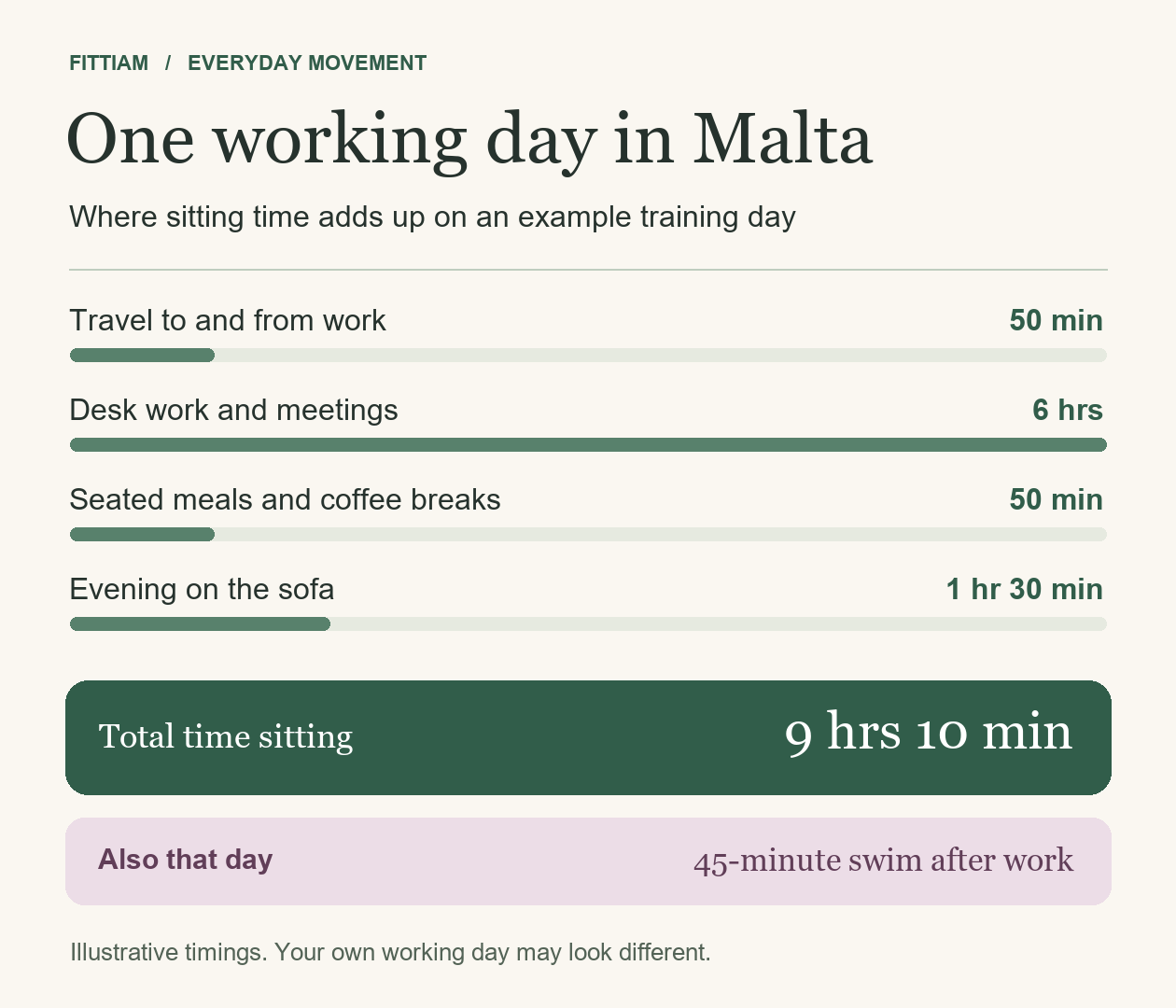
| Part of your day | One example | Your day |
|---|---|---|
| Travel, including the journey home | 50 minutes | ___ |
| Desk work and meetings, excluding breaks | 6 hours | ___ |
| Meals and coffee breaks spent sitting | 50 minutes | ___ |
| Evening on the sofa, reading or watching television | 1 hour 30 minutes | ___ |
| Total time sitting | 9 hours 10 minutes | ___ |
Now add two lines beneath your total: “When did I sit longest without a break?” and “When did I exercise?”
In this example, someone could have spent 45 minutes swimming after work as well as sitting for 9 hours and 10 minutes. Record the swim alongside the total. Subtracting it would hide 45 minutes that were actually spent sitting. The eight-and-a-half-hour figure in the Maltese survey is a reporting category. For your own check, the most useful finding is a particular stretch of time you can change.
Choose one change that fits the day you actually have
Suppose your longest spell runs from 9.00 to 11.30. You make a coffee before opening your laptop, attend two meetings and go straight into answering emails. The end of the second meeting is your opportunity. Before opening your inbox, walk to the kitchen to refill your glass. Try it again after the same meeting tomorrow. See whether it fits a busy day as easily as a quiet one.
Your own opportunity may fall somewhere else:
- If you commute by car, choose an errand near work that you can comfortably do on foot. Even if the journey to the office has to be a drive, collecting lunch can include a walk.
- If your calls are back to back, look for one where you only need to listen. If the conversation is private and the route is clear, you could take it while walking around the room.
- If the afternoon heat makes a walk outdoors uncomfortable, choose an indoor route or leave the outdoor walk for a cooler part of the day.
- If you need to stay seated, choose movement that works for you. Reaching, moving your arms or doing a seated exercise you already know can give you a change from working at a keyboard.
If your longest stretches happen at home, you can find more ideas for arranging calls, lunch and the end of the working day in my guide to working from home in Malta.
Where does your evening workout fit?
For adults aged 18–64, Malta’s guidance recommends 150–300 minutes of moderate aerobic activity a week, or 75–150 minutes of vigorous activity, or a combination of the two. It also recommends strengthening the main muscle groups on at least two days a week. A brisk walk can count towards the aerobic total. One way to judge the pace is whether you can still talk comfortably but would find it difficult to sing. Malta’s Be Active guidelines for adults · WHO’s Malta physical activity factsheet
That gives you two different ways to plan a Tuesday. You might book an evening strength class because you enjoy training with other people. At lunchtime, you might walk to collect your sandwich because you’ve spent the morning in meetings. Both choices have a place in the same day. If you already enjoy your evening session, keep it in the diary and experiment with what happens before it.
Frequently Asked Questions
Does a short walk count if I only have a few minutes?
Yes. A gentle walk replaces a few minutes of sitting with light activity. If you walk briskly enough to reach moderate intensity, those minutes can also contribute to your weekly aerobic activity. WHO physical activity guidelines
My phone shows plenty of steps. Why keep a sitting diary as well?
A daily step total tells you how many steps your phone recorded. You could collect most of them on one evening walk. A rough note of when you sat down and got up tells you something different, such as whether you spent the whole morning in your chair. Try the diary for one day and see what you learn.
How often should I get up from my desk?
Build short, regular opportunities to move into your work. The end of a call, a trip to refill your water or a change of task can be easier to act on than an alarm that always goes off halfway through a meeting. If your schedule rarely leaves room for a break, discuss where one could fit with the people who plan the work. Health and Safety Executive guidance on breaks and changes of activity
I’ve missed my evening class. Is it still worth going for a walk?
Yes. Choose a walk that fits the time and energy you have. You can return to your usual class at the next opportunity. For ideas you can use during the working day too, see desk work in Malta and everyday movement.
If you’d like to move with other people in Naxxar

I’m Judit, and I teach group classes in Naxxar. If you enjoy having a regular time set aside for strength work, you’re welcome to try Gymstick. We use a bar with resistance bands, and I’ll show you how to adjust the tension so you can work at your own level. You can read more about Gymstick and my other group classes in Naxxar.