

Think of two days you spent at the same desk. On one, you went out for lunch, walked over to a colleague and finished on time. On the other, three video calls ran into one another, you ate with your inbox open and you answered a “quick question” after dinner. If your neck or back felt different on those two evenings, you might struggle to explain it by looking at the chair alone.
When you spend long hours at a computer, it’s worth asking two questions. Can I work comfortably here? And does the way my day is organised give me a chance to move and a clear time to finish? The answers may lead to quite different changes.
What did researchers find among teleworkers in Malta?
In a survey of 459 people working remotely for IT and communications organisations in Malta, 55.8% reported pain in at least one area of the body. The back was the most commonly reported area, followed by the neck and shoulders.
The researchers asked about more than furniture. People who worked during their time off, exercised less often or reported higher levels of burnout were also more likely to report pain. The survey captured associations within this particular group. It couldn’t establish what caused an individual’s symptoms, and the percentage applies to the people surveyed rather than everyone who works at a computer in Malta. Read the University of Malta study.
Which part of your working day would you change?
Try this on one ordinary workday. A few words on paper will do. The aim is to spot something specific enough to change tomorrow.
| When to check | What to jot down | What it might look like |
|---|---|---|
| When you first want to shift position | What are you doing? Can you change position comfortably and still do the task? | “Reviewing a spreadsheet. I keep leaning forwards to read the figures.” |
| At the end of your busiest stretch | When did you last leave the screen? What kept you there? | “Three client calls in a row. I had enough time to open the next file, but no time to get up.” |
| The following morning | When did work actually finish yesterday? What took you back online? | “Finished at six. Opened the laptop again at eight because I wasn’t sure whether the message could wait.” |
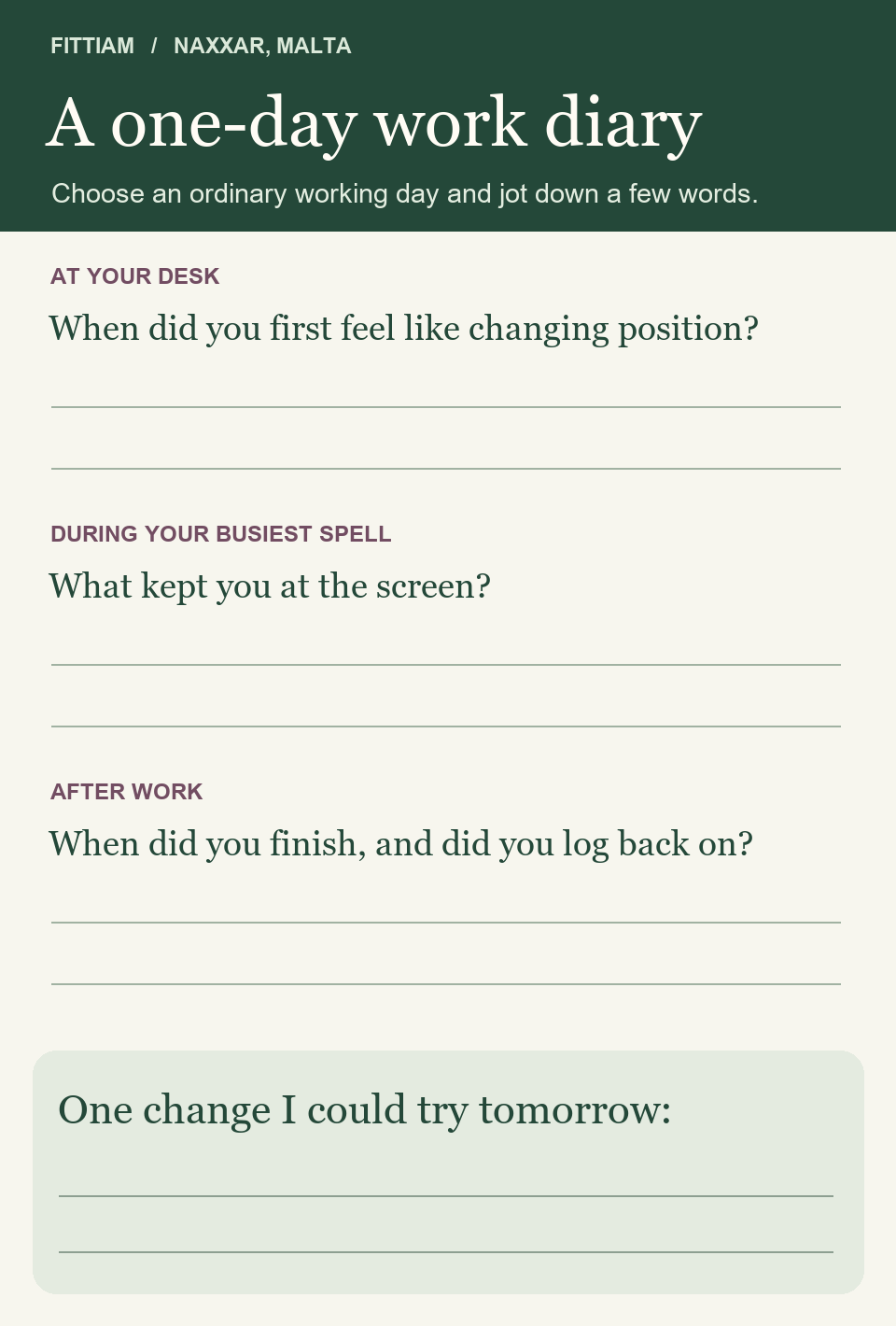
These notes point to three different decisions. You could try increasing the spreadsheet zoom straight away. A gap between client calls may need agreement from whoever manages the bookings. An evening message raises a question about when a reply is expected. Pick the issue that crops up most often on your working days.
If the first row sounds familiar, there’s a workstation illustration in my guide to working from home in Malta.
What if your diary leaves no room for a break?
Start with a point in the day you can recognise. After sending a report, you might have time to fetch water before opening your inbox. If a colleague rings to talk something through and you don’t need the screen, you might take the call standing or walk a few steps. Short, frequent changes of activity give you opportunities to move during computer work.
A reminder is handy when you forget to move. It’s less useful when you work on a support line and somebody has to answer the next call. If you have little control over your diary, bring one concrete example to your team leader. You could say, “On Tuesday I had calls from nine until eleven without a gap. Could we try staggering cover so each of us can step away?” That gives you both something practical to try and review.
When does your working day actually end?
If you work in Malta with colleagues or clients in another time zone, a message can arrive during their afternoon and your evening. Before changing your notification settings, find out what your team expects. A useful question is, “If something needs my attention after I finish, how will I know it’s urgent?”
You might agree that the on-call colleague takes urgent calls while routine messages wait until the next working day. If you’re the person on call, a clear handover time matters too. If you work for yourself, the equivalent might be telling a client when they can expect a reply.
There’s also the evening when nobody has messaged, but you reopen a file because you’re worried you’ll lose your place. Before you sign off, leave yourself a precise first step for tomorrow. “Check the two missing figures in the client report” is easier to come back to than “finish report”.
Frequently Asked Questions
Does checking my phone count as a screen break?
It gives you a break from the task, but you’re still looking at a screen. If you’ve spent the morning reading small text, try leaving the phone on your desk while you make a cup of tea. You get a change of focus and an opportunity to move.
I already exercise after work. Is it still worth changing my working day?
Yes. You can enjoy an evening swim or a gym session and still have a morning with very few opportunities to leave your chair. If you’d like to see where those stretches occur, try the one-day sitting check.
Should I buy a new chair if I feel uncomfortable by the afternoon?
First, notice when the discomfort appears. If your feet don’t reach the floor or you have to lean away from the backrest to type, you have something specific to adjust or raise in a workstation assessment. If the chair feels comfortable until a long run of meetings, look at the schedule as well before spending money. If pain persists, worsens or interferes with everyday activities, speak to your GP or a physiotherapist for advice.
If you’d like help finding movement you enjoy

I’m Judit, a personal trainer in Naxxar. If you’d like to be more active around a demanding job, we can start with the week you actually have. Tell me which movements you enjoy, how much time feels realistic and what you’d like to feel more confident doing. That gives us a starting point for your first session. Explore personal training in Naxxar.